
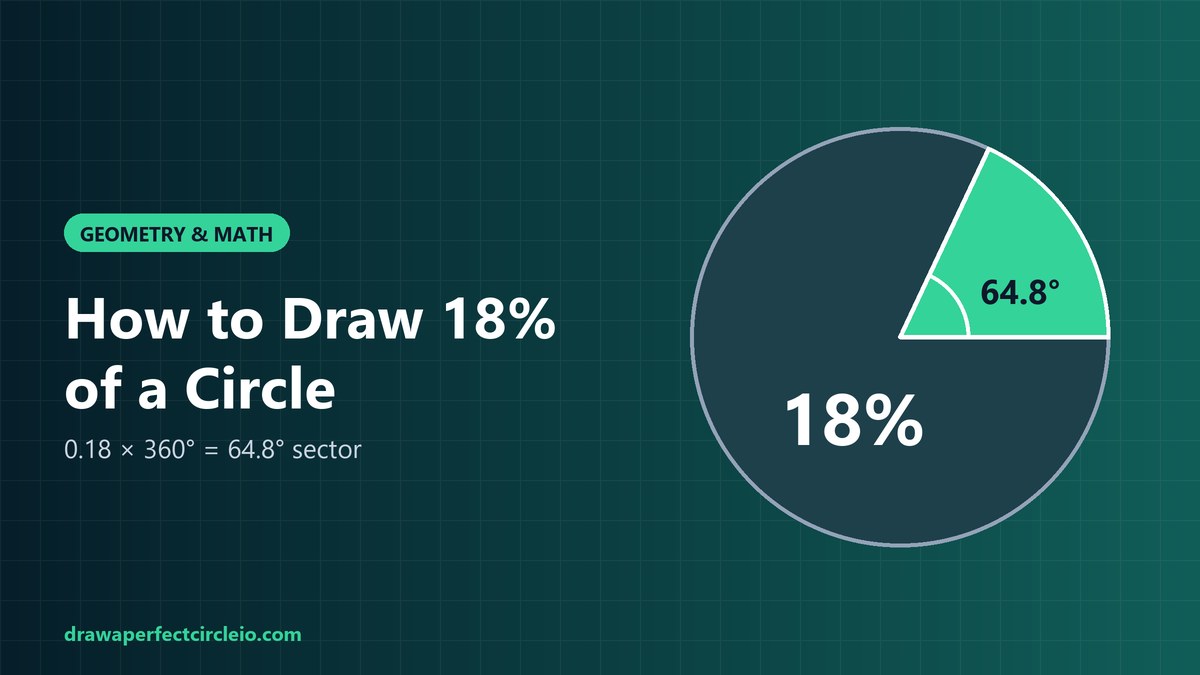
To learn how to draw 18% of a circle, multiply 0.18 by 360° to get a central angle of 64.8°. Draw a circle, draw one radius, then use a protractor at the center to mark 64.8° from that radius and draw a second radius. The slice between the two radii is exactly 18 percent of the circle.
What 18% of a circle actually means
A full circle is 360 degrees, and a percentage of a circle is a share of those 360 degrees. When people ask about 18 percent of a circle, they almost always mean a sector: the pie-slice shape bounded by two radii and the arc between them.
The size of a sector is set by its central angle, the angle the two radii make at the center. Get that angle right and the slice is correct for any circle, whether it is 2 cm across or 2 meters across.
That is why the radius does not change the answer. A 64.8 degree angle is 18% of the turn in every circle, so the only thing that changes with size is how long the arc is and how much area the slice covers.
The percent-to-degrees formula
Converting any percentage of a circle into degrees takes one multiplication:
degrees = (percent ÷ 100) × 360
For 18%, that gives 0.18 × 360 = 64.8°. A handy shortcut is to multiply the percentage by 3.6, since 360 ÷ 100 = 3.6. So 18 × 3.6 = 64.8.
You can run the formula backward too. If you measure a slice at 64.8°, divide by 360 and multiply by 100 to get 18%. This is useful when you want to check a slice you have already drawn.
In radians
If you work in radians, a full circle is 2π. Eighteen percent of 2π is 0.36π, which is about 1.131 radians. You can also convert directly: 64.8 × π ÷ 180 = 0.36π ≈ 1.131 rad. Radians matter mostly for calculators, programming, and graphing tools that expect angles in that unit.
How to draw 18% of a circle with a compass and protractor
This is the most accurate hand method, and it only needs a compass, a protractor, a sharp pencil, and a ruler. If you want a cleaner outline first, our guide on how to draw a perfect circle covers compass technique in detail.
- Draw the circle. Set your compass to the radius you want, for example 5 cm. Press the point firmly into the paper and rotate in one smooth motion. Keep the center hole visible.
- Draw the first radius. Use a ruler to draw a straight line from the center to the edge. A horizontal line pointing right is easiest because it matches the protractor’s baseline.
- Position the protractor. Put the protractor’s center mark (the small hole or crosshair) exactly on the circle’s center. Line up the 0° baseline with your first radius.
- Mark 64.8°. Read the scale that starts at 0 on your radius. Find 64° and 65°, then place a tiny dot about four-fifths of the way from 64 to 65. That dot is 64.8°.
- Draw the second radius. Remove the protractor and use the ruler to connect the center to your dot, extending the line all the way to the edge of the circle.
- Shade the sector. The region between the two radii and the arc is 18% of the circle. Shade it lightly or outline it in ink.
What if your protractor only reads whole degrees?
Most school protractors mark only whole degrees, so rounding to 65° is the practical choice. That slice is 65 ÷ 360 ≈ 18.06% of the circle, an error of 0.2°, or about 0.3% of the intended angle.
On a 5 cm circle, that 0.2° moves the end of the arc by only about 0.017 cm, far less than the width of a pencil line. For homework, posters, and pie charts, 65° is fine. For technical drawing, use the chord method below to hit 64.8° more closely.
Arc length and sector area for 18% of a circle
Once you know the slice is 18% of the whole, you can get its measurements by taking 18% of the full circle’s measurements.
- Arc length = 0.18 × 2πr (18% of the circumference)
- Sector area = 0.18 × πr² (18% of the circle’s area)
Worked example with r = 5 cm
Say your circle has a radius of 5 cm.
- Circumference = 2π × 5 = 10π ≈ 31.42 cm.
- Arc length = 0.18 × 10π = 1.8π ≈ 5.65 cm.
- Full area = π × 5² = 25π ≈ 78.54 cm².
- Sector area = 0.18 × 25π = 4.5π ≈ 14.14 cm².
If you need the outline length of the whole slice, add the two radii to the arc: 5.65 + 5 + 5 ≈ 15.65 cm. You can also cross-check the arc with radians: 1.131 rad × 5 cm ≈ 5.65 cm, which matches.
Drawing an 18% slice in a pie chart
Pie charts are the most common reason people need an 18 percent slice. The trick is to convert every category to degrees first, then draw the slices one after another around the center.
Here is an example with five categories that add up to 100%:
| Category | Percent | Degrees (percent × 3.6) |
|---|---|---|
| A | 30% | 108° |
| B | 25% | 90° |
| C | 18% | 64.8° |
| D | 15% | 54° |
| E | 12% | 43.2° |
| Total | 100% | 360° |
- Draw your circle and a starting radius, usually straight up (the 12 o’clock position).
- Measure the first slice (108°) from the starting radius and draw its edge.
- Use that new edge as the baseline for the next slice (90°), and keep going.
- When you reach category C, measure 64.8° from the previous edge.
- The last slice should close exactly at your starting radius. If it does not, recheck your degree math.
Measuring each slice from the previous edge is quick, but small rounding errors add up as you go around. If precision matters, measure cumulative angles from the starting radius instead: 108°, 198°, 262.8°, 316.8°, and back to 360°.
How to draw 18% of a circle without a protractor
No protractor? You can still get an accurate 64.8 degree angle using a ruler and compass and a little trigonometry. This is called the chord method.
A chord is the straight line joining the two ends of the arc. For a central angle θ, the chord length is 2r × sin(θ ÷ 2). For 18% of a circle, θ ÷ 2 = 32.4°, so:
chord = 2r × sin(32.4°) ≈ 1.0716 × r
On a 5 cm circle, the chord is about 5.36 cm. On a 10 cm circle, it is about 10.72 cm.
- Draw the circle with your compass and draw one radius to the edge.
- Calculate the chord length: multiply your radius by 1.0716.
- Open the compass to that chord length, measured against a ruler.
- Put the compass point where the first radius meets the circle and swing a small arc that crosses the circle.
- Draw a line from the center to that crossing point. The angle between the two radii is 64.8°.
This method is often more accurate than a cheap protractor, because rulers are easier to read precisely than tiny angle marks. Notice that the chord is only slightly longer than the radius. That makes sense: a 60° chord equals the radius exactly, and 64.8° is just a bit more.
If you do not have a compass either, see our guide on how to draw a circle without a compass using string, a pin, or household objects, then apply the chord step with a ruler.
Drawing 18% of a circle digitally
Software can draw a perfect 18% sector in seconds, and you never have to measure an angle.
Excel or Google Sheets
- Type your category labels in one column and their values in the next. For a single 18% slice, enter 18 and 82.
- Select both columns.
- In Excel, choose Insert > Pie chart. In Google Sheets, choose Insert > Chart, then set the chart type to Pie chart in the chart editor.
- The software converts the values to angles for you, so the 18 value becomes a 64.8° slice.
- To show just the slice, set the 82% portion’s fill to white or no color.
GeoGebra
GeoGebra gives you exact geometry. In the input bar, try these commands:
A = (0, 0)to place the center.B = (5, 0)to set a point on the circle, giving a radius of 5.C = Rotate(B, 64.8°, A)to rotate B by 64.8° around A.CircularSector(A, B, C)to draw the 18% sector. Many versions also acceptSectorwith a circle and two points.
Check the sector’s value in the Algebra view to confirm the area is about 14.14 square units. If you are new to GeoGebra’s construction tools, our walkthrough on drawing a director circle in GeoGebra is a good place to practice the interface.
Common percentages of a circle in degrees
Keep this table handy for pie charts and geometry problems. Each value is the percentage multiplied by 3.6.
| Percent of circle | Central angle | Fraction |
|---|---|---|
| 5% | 18° | 1/20 |
| 10% | 36° | 1/10 |
| 12.5% | 45° | 1/8 |
| 18% | 64.8° | 9/50 |
| 20% | 72° | 1/5 |
| 25% | 90° | 1/4 |
| 33.3% | 120° (approx.) | 1/3 |
| 50% | 180° | 1/2 |
| 75% | 270° | 3/4 |
Note that 33.3% is a rounded value. Exactly one-third of a circle is 120°, while 33.3% × 3.6 gives 119.88°.
Common mistakes when drawing 18 percent of a circle
- Using 18° instead of 64.8°. 18° is only 5% of a circle. Always convert the percent with × 3.6.
- Reading the wrong protractor scale. Protractors have two rows of numbers. Use the row that starts at 0 on your baseline, or you will mark 115.2° instead of 64.8°.
- Misplacing the protractor center. If the center mark is even slightly off the circle’s center, the angle will be wrong. Check alignment before you mark.
- Measuring the chord from the wrong point. In the chord method, the compass point must sit exactly where the first radius meets the circle, not at the center.
- Forgetting to square the radius. Sector area uses r², so a 5 cm radius gives 25π, not 5π.
- Letting pie chart slices drift. Rounding many slices can leave a gap or overlap at the end. Use cumulative angles when accuracy counts.
Frequently asked questions
How many degrees is 18% of a circle?
18% of a circle is 64.8 degrees. You get this by multiplying 0.18 by 360°, or by using the shortcut 18 × 3.6. This central angle is the same for every circle, no matter how large or small, because percentages of a circle depend only on the angle, not the radius.
Can I just use 65° instead of 64.8°?
Yes, for most purposes. A 65° slice is about 18.06% of a circle, an error of just 0.2°. On a 5 cm circle that shifts the arc’s endpoint by roughly 0.017 cm, which is smaller than a pencil line. For precise technical work, use the chord method or software instead.
What is the area of 18% of a circle?
The area is 0.18 × πr². For a circle with a 5 cm radius, the full area is 25π ≈ 78.54 cm², so the 18% sector is 4.5π ≈ 14.14 cm². Remember to square the radius before multiplying, since forgetting that step is the most common error.
What is the arc length of an 18% sector?
The arc length is 0.18 × 2πr, which is 18% of the circumference. With a 5 cm radius, the circumference is 10π ≈ 31.42 cm, so the arc is 1.8π ≈ 5.65 cm. In radians, the angle is about 1.131, and 1.131 × 5 gives the same result.
How do I draw 18% of a circle without a protractor?
Use the chord method. Multiply your radius by 1.0716 to get the chord length, set your compass to that length, and swing an arc from the end of your first radius so it crosses the circle. Draw a line from the center to the crossing point to form a 64.8° angle.
What is 18% of a circle in radians?
18% of a circle is 0.36π radians, or about 1.131 radians. A full circle is 2π radians, so 0.18 × 2π = 0.36π. You can confirm by converting 64.8° with the formula degrees × π ÷ 180, which gives the same value of roughly 1.131.
Conclusion
Now you know how to draw 18% of a circle: convert the percentage to a 64.8° central angle, draw two radii that far apart, and the sector between them is your slice. Use a protractor for speed, the chord method for accuracy without one, or a spreadsheet or GeoGebra when you want a perfect digital result. If you are making diagrams in documents, you may also like our guide to drawing a circle in Google Docs.